
Redeemed Contracting · 2026 Cost Guide
What Is the Most Expensive Part of a Kitchen Remodel?
An honest Northeast Ohio cost breakdown — where the money actually goes and how to plan a budget that reflects reality.
Let's answer the question right away: in most kitchen remodels, cabinets are the single most expensive part of the project.
Every kitchen is different, and we'll get into the cases where something else takes the top spot. But across the projects we see here in Northeast Ohio, cabinetry is almost always the biggest line item on the budget.
That said, cabinets are not the whole story. Labor, mechanical work, structural changes, and the finishes you pick can each add thousands to your total. Sometimes tens of thousands.
This guide walks you through where kitchen remodeling money actually goes — with real Northeast Ohio numbers, an explanation of what drives costs up or down, and help setting a budget that reflects reality instead of a number you saw on a home improvement show.
What Homeowners Need to Know
- Cabinets are typically the most expensive part of a kitchen remodel, accounting for 25%–40% of the total budget.
- Stock cabinets run $6,000–$13,000 installed; semi-custom $13,000–$28,000; custom $28,000–$55,000+.
- Labor is the second-largest category at roughly 20%–25% of the total, covering every skilled trade on the job.
- Structural changes like removing a load-bearing wall ($5,000–$20,000+) can sometimes become the single biggest cost of the project.
- Moving plumbing, gas, or electrical is significantly more expensive than replacing in place — keeping your existing layout saves money.
- A mid-range Northeast Ohio kitchen remodel typically runs $50,000–$80,000; high-end kitchens run $70,000–$150,000+.
- Finalizing all selections before demo begins is the most effective way to control costs and avoid mid-project surprises.
Table of Contents
- 1. Why Cabinets Are Usually the Biggest Cost
- 2. Countertops: The Second Big Material Cost
- 3. Labor Costs: What You're Really Paying For
- 4. Mechanical Work: Electrical, Plumbing & More
- 5. Structural Changes: The Big Budget Mover
- 6. Sample Budget Breakdown
- 7. How to Get the Most Value From Your Budget
- 8. So, What Is the Most Expensive Part?
- 9. Frequently Asked Questions
Biggest Line Item
Why Cabinets Are Usually the Biggest Cost
Cabinetry typically accounts for 25% to 40% of a full kitchen remodel budget. On a larger or more custom kitchen, it can be even more. Here's why they carry so much weight.
Stock vs. Semi-Custom vs. Custom
Fixed sizes and a limited set of finishes. The most affordable option, and for many kitchens they work just fine.
More sizes, more finishes, and more storage options. Where most of our clients land — strong value for the investment.
Built to fit your exact space in any style and finish. The most expensive option, but they use every inch of an awkward layout and deliver a truly one-of-a-kind result.
Why Material Quality Matters
Two cabinets can look the same in a showroom and be built completely differently behind the doors. Cheaper cabinets often use particleboard boxes and thin backs. Better cabinets use plywood boxes, solid wood doors and frames, and sturdier joinery. That difference shows up in how the cabinets hold up over ten or twenty years of daily use — and it shows up in the price.
Matching quality to your situation
Storage Upgrades and Soft-Close Hardware
A big chunk of cabinet cost comes from what's inside them. Pull-out trash drawers, deep pot drawers, spice racks, lazy Susans, tray dividers, and built-in organizers all add up. None are huge on their own, but a kitchen full of smart storage upgrades can add a few thousand dollars to the cabinet order. Soft-close hinges and drawer glides have become close to standard on better cabinets — most homeowners love them, and they add cost compared to basic hardware.
Custom Sizing and Installation Labor
Setting cabinets correctly is skilled work. They have to be level, plumb, and square — even when the floor and walls are not, which is common in older Northeast Ohio homes. If your kitchen needs custom-sized cabinets or filler pieces to handle an odd wall, that takes extra time and craftsmanship. Add it all together, and you can see why cabinets usually sit at the top of the budget.
Want a real number for your kitchen?
We'll walk through your space and give you honest pricing — no pressure, no calculator guesswork.
Second Biggest Material
Countertops: The Second Big Material Cost
After cabinets, countertops are often the next material that makes homeowners pause. The good news is you have real choices here, at very different price points.
Quartz
Most PopularThe most popular choice we install right now — durable, low-maintenance, and available in a huge range of looks.
Granite
Natural StoneNatural stone, so every slab is a little different. Heat-resistant and beautiful, though it needs periodic sealing.
Butcher Block
Warm & NaturalA warm, natural look that works great for islands and accent runs. Needs oiling and care around water and heat.
Laminate
Budget-FriendlyToday's laminate looks far better than what you remember from decades ago — a smart choice when you're keeping a remodel light.
Why Fabrication and Installation Add So Much
A lot of people look at the slab price and assume that's the number. But the stone has to be measured, cut, and finished to fit your exact kitchen — that's called fabrication, and it's a big part of the cost. Edge profiles, sink cutouts, seams, and the careful work of templating your space all take time and equipment.
For a typical kitchen with 40 to 55 square feet of counter, a mid-grade quartz job often lands somewhere around $4,500 to $8,000 installed. The exact number depends on your material, your edge choice, and how complex the layout is.
The Invisible Cost
Labor Costs: What You're Really Paying For
A big part of any kitchen remodel isn't a product you can hold. It's skilled labor. A full kitchen remodel touches many trades, often in this order:
Demolition — removing old cabinets, counters, flooring, and sometimes walls
Framing — adjusting or building new structure
Drywall — patching, hanging, finishing, and prepping walls and ceilings
Flooring installation — across the whole space
Cabinet installation — set level, plumb, and square
Backsplash tile — precise, detailed work
Painting — walls, ceilings, and trim
Finish work — trim, hardware, and the small details that make a kitchen feel done
When a bid comes in much lower than everyone else's, it often means the labor is less experienced, fewer skilled trades are involved, or the contractor hasn't fully accounted for the work. Good labor costs what it costs.
A backsplash that's set crooked or grouted poorly will bother you every day. Drywall that isn't finished smooth shows under your new lighting. Trim that's cut sloppy makes an expensive kitchen look cheap. This is the difference between a kitchen that looks great for a week and one that looks great for twenty years.
Behind the Walls
Mechanical Work: Electrical, Plumbing, and More
Behind your walls and under your floor is the mechanical work that makes a kitchen function. You don't see most of it when the job is done, but it's a real part of the budget.
Electrical Upgrades. Modern kitchens need a lot of power. Code requires dedicated circuits for many appliances, GFCI-protected outlets, and proper wiring throughout. In older Northeast Ohio homes, the existing wiring often hasn't been touched since the house was built. Sometimes the panel needs to be updated before an inspector will sign off. Adding outlets, new circuits, and improved lighting all add to the electrical portion of your budget.
Plumbing Relocation. If your sink stays where it is, plumbing is fairly simple. The cost climbs when you move things. Relocating a sink, adding a line for a pot filler, or running new supply and drain lines for an island all mean opening up walls or floors and rerouting pipe.
Gas Line Relocation. If you're moving your range or cooktop, the gas line often has to move with it. That's specialized work that has to be done safely and to code, and it adds cost compared to leaving the appliance where it is.
Venting. A proper range hood that vents to the outside is a real upgrade for air quality, but running new ductwork through walls, ceilings, or cabinets takes labor and materials. A recirculating hood is cheaper but doesn't move air out of the house the same way.
Lighting Improvements. Good lighting changes how a kitchen feels. Recessed lights, under-cabinet lighting, and pendant fixtures over an island all improve both function and appearance. Each is an electrical add, and together they can meaningfully affect the budget.
The golden rule of mechanical work
The Big Budget Mover
Structural Changes
This is the category that can swing a budget the most — and also creates the biggest visual transformation.
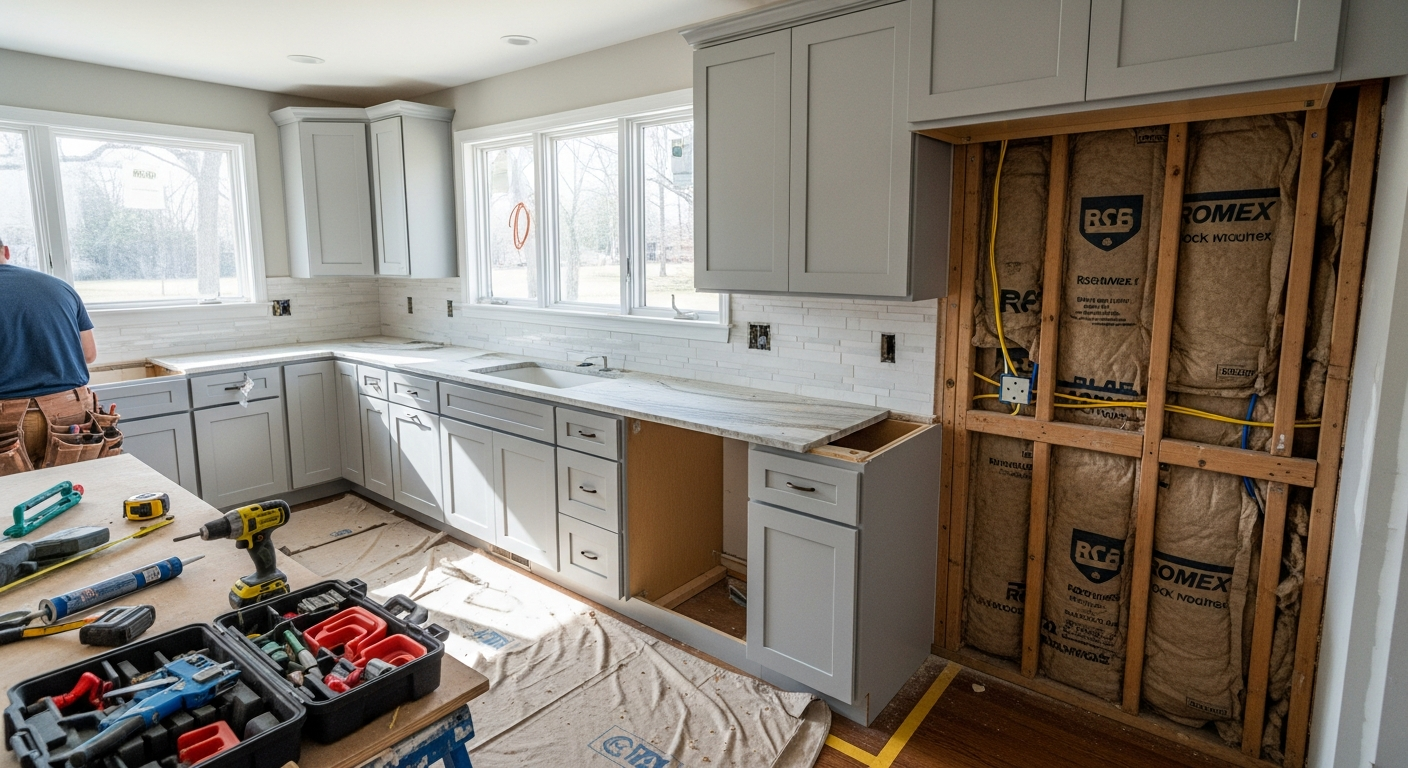
Removing Walls. Opening up a kitchen by removing a wall is one of the most requested changes we see. Knocking out a non-load-bearing wall is the simpler case, often running around $1,500 to $5,000 or more once you account for the demo, the patching, and the cleanup. A load-bearing wall is a different project entirely.
Installing Beams. When a load-bearing wall comes out, a beam has to go in to carry the load. Depending on the span and the structure above, that work commonly runs from $5,000 to $20,000 or more. Larger or more complex structural projects can run higher than that.
Structural Engineering. For load-bearing changes, a structural engineer often has to design the beam and confirm it's sized correctly. That's a real, usually non-negotiable cost. It protects your home and is typically required for permitting.
Permits. Structural, electrical, and plumbing work generally requires permits. In Northeast Ohio, contractor registration and permitting are handled at the local or municipal level. A reputable contractor will pull the permits your project needs and handle the inspections as part of the process. Skipping permits to save money creates real problems when you sell, refinance, or file an insurance claim later.
Structural changes are expensive. But when a closed-off kitchen becomes an open, connected living space, the transformation is often the thing homeowners are most thrilled about. For a deeper look at what's involved, see our guide on removing a wall during a kitchen renovation.
Want a real number for your kitchen?
We'll walk through your space and give you honest pricing — no pressure, no calculator guesswork.
Where the Money Goes
Sample Budget Breakdown
Here's roughly how the money tends to break down on a mid-range Northeast Ohio kitchen remodel in the $50,000 to $80,000 range. These are approximate percentages — your kitchen will vary based on your choices, but this gives you a realistic feel for where the budget goes.
Cabinets
Almost always the biggest single piece.
Labor
The skilled trades that pull it all together.
Countertops
Material, fabrication, and installation.
Flooring
Material and installation across the space.
Electrical
Circuits, outlets, and lighting.
Plumbing
Higher if you're moving the sink or adding a line.
Backsplash Tile
Detailed work quoted per job.
Paint
Walls, ceilings, and trim.
Permits
Varies by municipality and scope.
This breakdown covers construction and materials. Appliances are usually a separate line homeowners budget for on their own, and they can range from a few thousand dollars to well into five figures depending on what you choose. It's also smart to keep a contingency set aside — older homes often hide a surprise or two behind the walls.
For a deeper look at how to plan your investment, see our Kitchen Remodel Investment Guide.
Spend Smarter
How to Get the Most Value From Your Budget
After years of these projects, here's where we'd tell you to focus your dollars.
Prioritize Layout. A great-looking kitchen that doesn't function well is a daily frustration. Before you fall in love with cabinet colors and countertop samples, get the layout right. Think about the flow between your sink, stove, and refrigerator, where you have prep space, and how people move through the room. A smart layout will make you happier than any finish.
Invest in Cabinetry. Since cabinets are the biggest piece and the hardest to change later, this is the place where spending a little more usually pays off. Solid cabinet construction lasts, and it sets the tone for the whole kitchen. You don't need the most expensive option. You need cabinets built well enough to handle how your family actually lives.
Avoid Trendy Upgrades That Age Quickly. Some choices look amazing this year and dated in five. A very bold tile, an unusual finish, or a trendy color can be the thing you regret first. Put your money into quality and timeless choices, then add personality in ways that are easy and cheap to change later — like paint, hardware, and decor.
Plan Before Construction Begins. The most expensive changes are the ones you make after demo has started. Every 'actually, can we move that' mid-project costs time and money. Spend real time in the planning phase. Pick your materials, finalize your layout, and make your decisions before the first cabinet comes out. A well-planned kitchen runs smoother, finishes faster, and almost always costs less than one figured out on the fly.
The Short Answer
So, What Is the Most Expensive Part of a Kitchen Remodel?
For most homeowners, the answer is cabinets — typically the single largest expense in a kitchen remodel, often 25% to 40% of the whole budget.
But cabinets alone don't tell you what your kitchen will cost. Labor, mechanical work like electrical and plumbing, and structural changes like removing a wall can each become major budget drivers in a hurry. On some projects, structural work becomes the biggest cost of all.
That's exactly why we'd encourage you to talk with a professional remodeling contractor before you lock in a budget. A real conversation about your space, your goals, and your home's existing condition will give you a far more accurate number than any online calculator.
FAQ
Frequently Asked Questions
What is the most expensive part of a kitchen remodel?
How much does a kitchen remodel cost in Northeast Ohio?
How much do kitchen cabinets cost?
Is it cheaper to keep my existing kitchen layout?
Do I need permits for a kitchen remodel?
Keep Reading
Related Articles
- ·Should I Remove a Wall During My Kitchen Renovation? — load bearing, costs, and when it's worth it
- ·Do You Get Your Money Back From a Kitchen Remodel? — how to think about ROI before you invest
- ·What's a Reasonable Kitchen Remodel Budget in Northeast Ohio? — real cost ranges before you commit to a number
- ·15 Questions to Ask Before Hiring a Remodeling Contractor — the checklist every homeowner should use
Akron · Canton · North Canton · Green · Jackson Township · Uniontown · Hartville · Hudson
Ready to Plan Your Kitchen Remodel?
If you're a homeowner in Northeast Ohio thinking about a kitchen remodel, we'd be glad to help you think it through. We'll give you honest answers, realistic pricing, and a clear plan — with no pressure.