
Redeemed Contracting · Homeowner Tips
Should You Paint the Ceiling the Same Color as the Walls?
A contractor's honest guide — no interior design fluff. Just practical advice on when it works, when it doesn't, and what to do room by room.
It's one of the most common questions we get at Redeemed Contracting when we're deep into a remodel: Should I paint the ceiling the same color as the walls?
The honest answer? Sometimes yes, sometimes no — and the difference between a room that feels intentional and sophisticated versus one that feels like you accidentally ran out of white paint comes down to a few key factors.
We work in homes across Stark County, Summit County, Green, Uniontown, North Canton, Hartville, Jackson Township, and the surrounding areas every week. We've seen this done beautifully and done poorly in equal measure. Here's what actually determines the outcome.
Planning an interior remodel in Northeast Ohio?
We'll walk through your space, talk through color decisions, and give you an honest picture of what's possible — no pressure.
Context First
Why Matching Ceiling and Wall Color Has Taken Off
For decades, white ceilings were essentially the default. Builders painted them white because white is bright, clean, and cheap — and most homeowners never questioned it. But several things shifted:
- ·Social media showed homeowners what rooms looked like when designers broke the rules
- ·Open-concept floor plans gave ceilings a bigger visual role with fewer walls to work with
- ·Farmhouse and modern aesthetics both pushed toward color and texture above eye level
- ·Homeowners got more confident about making bolder choices
The result is "color drenching" — where walls, ceiling, and sometimes even trim all get the same hue — becoming one of the most-discussed interior trends of the last five years. It works. But not everywhere, and not without preparation.
When to Do It
When Painting the Ceiling the Same Color as the Walls Works Really Well
1. Rooms with Low Ceilings
This surprises most people. You'd think painting a low ceiling a matching color would make the room feel more cramped — but the opposite is often true.
When your ceiling is a different color from your walls, your eye registers that contrast as a hard boundary. The room ends right there. When the ceiling flows into the walls with the same color, that boundary disappears and the space feels more continuous.
Especially true in finished basements
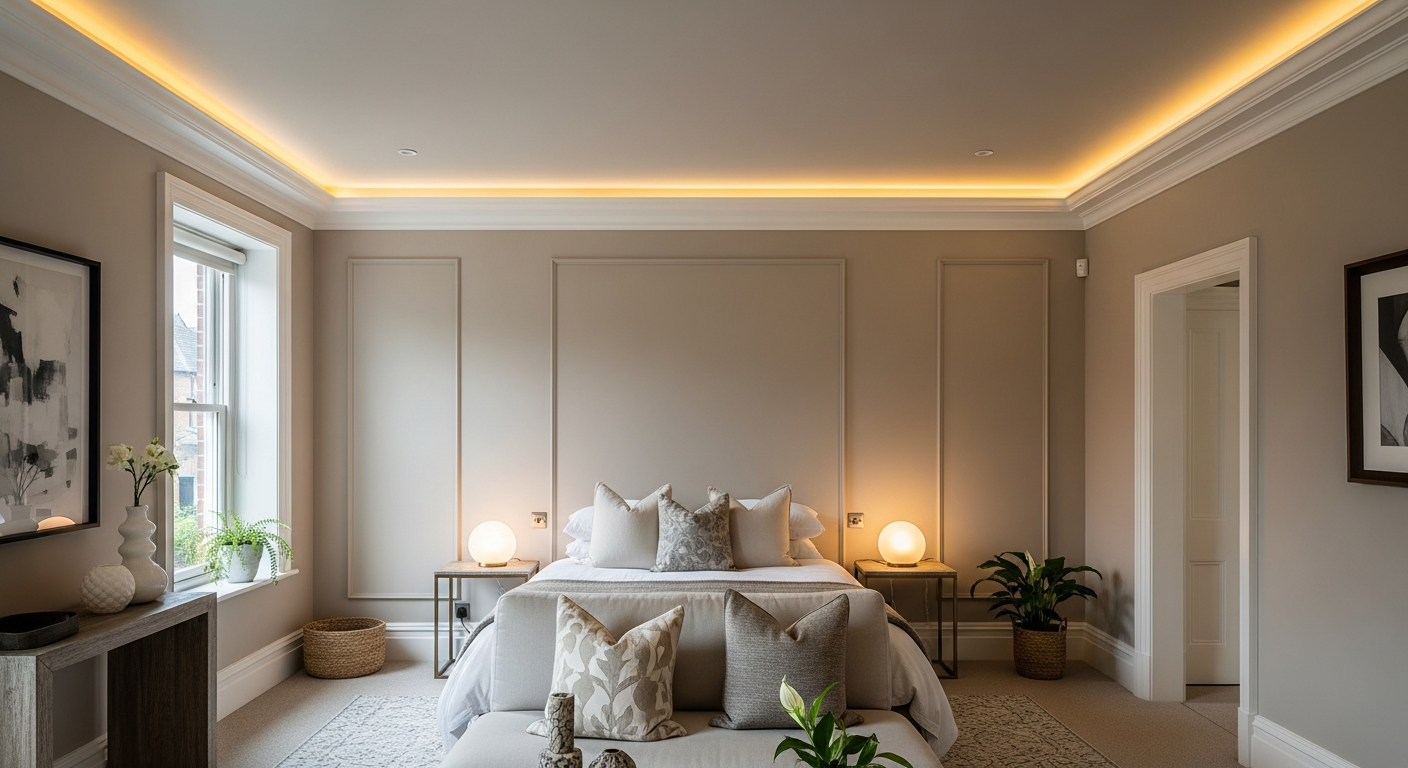
2. Bedrooms You Want to Feel Cozy and Restful
Think about it: when you're lying in bed, you're staring at the ceiling. If it's flat white, it's not doing much. But if it's a soft sage green, dusty blue, or warm taupe that matches the walls, the whole room wraps around you.
A deep navy or forest green bedroom with a matching ceiling is one of the most sophisticated looks in modern interior design — and it's not as risky as it sounds.
3. Bathrooms — Especially Smaller Ones
Bathrooms are a great place to experiment. The rooms are small, the impact is immediate, and the cost of repainting if you change your mind is low.
A bathroom remodel painted floor to ceiling in the same soft gray, warm white, or dusty blue reads as intentional and spa-like. It's one of the easiest ways to make a builder-grade bathroom feel custom without tearing everything out.
4. Hallways
Hallways are long, narrow, and often get limited natural light. A matching ceiling color makes them feel like a deliberate design choice rather than an afterthought — and creates a sense of flow that connects rooms naturally.
5. Dark or Moody Rooms
If you're going for a dramatic look — deep charcoal, forest green, burgundy — a white ceiling fights the mood you're trying to create. It's like wearing a tuxedo jacket with gym shorts.
For dark, moody rooms, painting the ceiling the same color (or even slightly darker) is almost always the right call. The room feels purposeful instead of half-finished.
When to Skip It
When Matching Ceiling and Walls Doesn't Work Well
Very High Ceilings in Already-Large Rooms
In a two-story great room or a living room with 10+ foot ceilings, painting the ceiling a dark or matching color can feel oppressive. All that ceiling mass starts to feel heavy. In rooms like this, a white or lighter ceiling actually helps the room breathe.
The exception: a soft, light color on both walls and ceiling — a pale warm white or soft linen — can still work beautifully. Problems arise when you put a heavy, dark color on a very large ceiling.
Ceilings with a Lot of Texture or Imperfections
This is a big one. White ceiling paint — especially flat white — is extremely forgiving. It hides imperfections, texture variations, and small flaws.
When you switch to a mid-tone or dark color, every imperfection gets highlighted. Roller marks, drywall tape lines, texture patterns — they all become more visible under a saturated color.
What we do on bathroom and basement remodels
Kitchens with Limited Ventilation
Kitchens accumulate grease, moisture, and airborne particles. Kitchen ceilings are generally easier to maintain in white — they're easier to clean and easier to touch up. If you paint the kitchen ceiling the same color as the walls, be honest with yourself about whether you'll actually wipe it down regularly when cooking residue builds up.
When You're Planning to Sell Within 1–2 Years
If resale is your primary goal, stick with light neutrals and a white ceiling. Northeast Ohio buyers are generally conservative. Neutral, cohesive color schemes appeal to the widest pool of buyers — and a fresh coat of paint is one of the cheapest things to change anyway.
The Height Factor
How Ceiling Height Changes Everything
7–8 Foot Ceilings
Common in Northeast Ohio ranches and colonials
Matching ceiling to walls is often a great idea at this height. The color unifies the space and softens the compressed feeling. Use softer, warmer tones and flat sheen.
9–10 Foot Ceilings
The sweet spot
Enough height to go darker and bolder without the room feeling heavy. Matching or even contrasting ceilings look great here — the most flexibility of any ceiling height.
10+ Foot or Vaulted Ceilings
Be more careful here
A white or near-white ceiling helps the room stay airy. If you want a matching look, stick with lighter tones. Reserve dark ceiling colors for specific accent zones, not the whole room.
Most homes in the Akron, Canton, and Cleveland area — especially ranch homes and colonials built between the 1950s and 1990s — have 8-foot ceilings. The good news: that's the height where matching works best.
Surface Matters
Flat Ceilings vs. Textured Ceilings: What You Need to Know
Smooth / Flat Ceilings
Ideal for matching wall colors. They accept color evenly, look clean, and give you the most control over the final result. If you're doing a full remodel and want color options, smooth ceilings give you the best starting point.
Light Texture (Orange Peel)
Can work with matched colors, especially in lighter to mid-range tones. Use a quality roller to avoid lap marks and keep your sheen consistent.
Heavy Knockdown or Popcorn Texture
Better off staying white. The texture catches light in unpredictable ways, and any color other than white makes those variations more obvious — not less. Skim-coating first is the right answer if you're committed to color.
Light Conditions
How Lighting Changes the Look — Especially in Northeast Ohio
Paint colors don't exist in a vacuum. Northeast Ohio isn't exactly known for relentless sunshine. We get gray winters and overcast stretches that can go for weeks. That matters when you're choosing ceiling colors.
Limited natural light (most Ohio winters)
Darker ceiling colors can make the space feel gloomy rather than cozy. Stick with lighter matched tones in rooms that rely on artificial light most of the year. South-facing rooms with good natural light give you more flexibility.
Recessed lighting
Your best friend with matching ceilings. It illuminates downward and doesn't draw attention to the ceiling surface. Flush-mount fixtures and ceiling fans with light kits also work well.
Warm vs. cool bulbs
If you're using warm-toned bulbs (2700K–3000K, common in Ohio homes), cooler wall colors like blues and grays can shift toward purple or lilac on the ceiling. Always test your paint in the actual room under your actual lighting before committing.
The Vocabulary
Monochromatic, Color Drenching, and Contrast Ceilings — Explained Simply
Monochromatic
One color in different shades. Your walls might be a medium blue-gray, your ceiling a lighter version of the same color, and your trim a crisp white. Coordinated without being identical — easy to execute and almost always looks intentional.
Color Drenching
The more dramatic version: walls, ceiling, AND trim all the same color — sometimes even the doors. The result is immersive and bold. It's not for every room, but in a moody study, a jewel-box dining room, or a dramatic powder bath, it can be stunning.
If you're considering color drenching, start small — a powder room or a bedroom — before committing to a whole floor.
Contrast Ceilings
The opposite approach: neutral walls, bold ceiling. A white room with a deep charcoal ceiling. A cream living room with a forest green ceiling. Done well, these are dramatic and architectural. Done poorly, they look like a mistake.
The key is intention. If the ceiling color ties to another element in the room — a piece of furniture, a rug, cabinetry — it reads as designed. If it comes out of nowhere, it reads as an accident.
The Right Finish
Paint Sheen for Ceilings: What Actually Works
Flat / Matte — the right choice 90% of the time
Non-reflective, hides imperfections, doesn't bounce light in strange ways. Whether you're using white or a matching color, flat or matte sheen is the standard for ceilings. Sheen on a ceiling draws attention to texture, roller marks, and surface inconsistencies.
Eggshell or Satin — for high-moisture areas only
Sometimes used in bathrooms where the slight sheen makes the paint easier to wipe down. But any sheen makes imperfections more visible. If you go this route, your surface prep needs to be meticulous.
Semi-Gloss or Gloss — avoid on ceilings
Unless you're making a very specific, intentional design statement (a lacquered ceiling in a formal dining room, for example), high-sheen ceiling paint causes more problems than it solves.
The Details
What to Do with Trim, Crown Molding, and Exposed Beams
Trim When Ceiling Matches Walls
The most common — and usually best — approach: keep the trim white or off-white. White trim grounds the room, gives it definition, and prevents the whole space from floating in color. If you want full color drench, you can paint the trim the same color, but a third unrelated color almost never works.
Crown Molding
Crown molding is designed to be seen. If you paint walls and ceilings the same color but leave the crown molding white — or slightly lighter — the molding pops beautifully. It's one of the best looks in a traditional or transitional home.
Exposed Wood Beams
The beam stays its natural or stained tone. The ceiling between the beams is where you make your color decision. Painting the ceiling between beams the same color as the walls — while letting the beams stay natural — is a gorgeous look in farmhouse, craftsman, or rustic-modern spaces. We see this done beautifully in finished basements throughout Hartville and Jackson Township.
Working on a bathroom, basement, or interior remodel?
We'll walk through your space, talk through color decisions, and give you an honest picture of what's possible — no pressure.
Room by Room
What We Actually See Work in Northeast Ohio Homes
Bathrooms — Great candidates.
Small rooms, high impact, low cost to repaint if you change your mind. Soft blue-grays, sage greens, and warm off-whites work beautifully floor to ceiling. Avoid very dark colors unless your lighting is strong.bathroom remodel
Bedrooms — Excellent candidates.
Matching ceilings make bedrooms feel restful. Soft deep blues, warm greens, and earthy taupe tones all work well in Northeast Ohio bedrooms, which often have limited southern exposure.
Basements — Where matching ceilings really shine.
Basements lend themselves naturally to cozy, casual vibes. A charcoal or deep navy basement with matching walls and ceiling feels like a purpose-built media room or bar area. Dark colors also help ductwork and mechanicals recede visually.basement finishing project
Living Rooms — Depends on the room.
In a standard 8-foot ceiling living room, matching works well with medium tones. Avoid heavy dark colors in living rooms you use during Ohio's long gray winters.
Kitchens — Generally easier to keep white.
Kitchens stay cleaner and touch up more easily with white ceilings. That said, a soft warm white or light linen on both walls and ceiling in a smaller kitchen can read as elegant rather than clinical.kitchen remodel
Hallways — Great candidates.
Linear, narrow, and often poorly lit — hallways benefit enormously from visual continuity. Matching walls and ceiling with white trim is one of the most effective low-cost upgrades you can make.
Home Offices — Can handle a darker, more immersive palette.
Many Northeast Ohio homeowners converted spare rooms to offices and never looked back. Deep green, slate blue, or warm charcoal walls and ceilings create a focused, intentional workspace.
The Case for White
When White Ceilings Still Make the Most Sense
White ceilings are the default for good reasons. Here's when you should stick with them:
- ·You have textured or imperfect ceilings that would look worse with color
- ·Your rooms get limited natural light and you need brightness
- ·You're planning to sell within 1–2 years and want broad buyer appeal
- ·Your home has ornate crown molding or detailed ceiling work that looks better defined with contrast
- ·Your ceilings are 10+ feet and you want the room to feel open and airy
- ·You're not ready to commit and want a safe starting point
White isn't wrong. It's just not the only option anymore.
Before You Pick Up a Brush
Practical Advice from a Contractor
Whether we're working on a bathroom, kitchen, or basement in Uniontown, Green, North Canton, or anywhere else in Northeast Ohio, here's what we tell homeowners before they commit to a color decision:
Test on both the wall AND the ceiling before committing
Colors look different on vertical versus horizontal surfaces because of how light hits them. A color that looks perfect on the wall sample can read completely differently on the ceiling. Always test both.
Check the color in your room's actual lighting — morning, afternoon, and evening
A color that looks perfect in the store might surprise you at home, especially in rooms with changing natural light or warm-toned bulbs.
Don't skip the prep
Matching colors show imperfections more than white. Fill every nail hole, repair every crack, and sand smooth before you roll. The prep work is what separates a professional-looking result from a messy one.
Use a quality flat ceiling paint
Not just 'any paint for ceilings.' The quality of the paint affects coverage, how it looks wet vs. dry, and how it holds up over time. Don't cut corners here.
Start with a low-stakes room
A bathroom or bedroom lets you test the concept without committing the whole house. If you love it, expand. If you're not sure, repaint and try again.
Factor in Northeast Ohio's light conditions
Colors that look great in a sun-drenched California home can feel oppressive here in January. Always choose paint colors with our local gray-sky months in mind — lean toward warmer undertones over cool grays and blues.
The Short Answer
The Bottom Line
Should you paint the ceiling the same color as the walls? In many cases — yes. It's one of the most effective ways to make a room feel intentional, cozy, modern, and complete.
But it's not a blanket rule. The right answer depends on your ceiling height, the room's natural light, your ceiling's surface condition, and what you're trying to accomplish in the space.
Test colors on both surfaces. Think through your trim and molding. Do the prep work right. Use flat paint. If you do those things, a matched ceiling almost always looks better than you feared — and often better than you hoped.
FAQ
Frequently Asked Questions
Should ceilings always be white?
No — white ceilings are the safe default, not the only option. White makes sense when you have imperfect or textured ceilings, limited natural light, or you're preparing to sell. But in many rooms — especially bedrooms, basements, bathrooms, and hallways — matching the ceiling to the walls produces a better result. Think of white as a starting point, not a rule.
Does painting the ceiling the same color make the room look bigger or smaller?
It depends on the room. In rooms with low or standard-height ceilings — which is most homes in Northeast Ohio — removing the contrast between wall and ceiling can make the space feel less confined by eliminating the hard visual boundary. In very large rooms with tall ceilings, the same technique can make the ceiling feel heavier. Matching colors generally work better in smaller, cozier spaces than in large, open rooms with significant ceiling height.
What sheen should ceilings be painted?
Flat or matte sheen is the right choice for almost every ceiling. It's non-reflective, hides imperfections, and produces a clean, consistent look. In high-moisture rooms like bathrooms, a very slight sheen (eggshell) can make wiping down easier — but flat is still preferred when surface quality allows. Never use semi-gloss or gloss on a ceiling unless it's a very deliberate design statement in a nearly flawless surface.
Should trim match the ceiling or the walls?
When ceiling and walls are the same color, trim is almost always best in white or crisp off-white. This grounds the room and gives it definition. If you want to go full color drench — ceiling, walls, and trim all the same color — that can be stunning in the right space. A third, unrelated trim color usually adds visual noise and doesn't work.
Are dark ceilings trendy or timeless?
Dark ceilings are a trend right now, but they're not new — dark-ceiling rooms have appeared in design history for centuries. Done well, with proper surface prep and a cohesive design, dark ceilings can absolutely age well. Done poorly, or in the wrong room, they'll look dated within a few years. The key is intentionality, not just reaction to a trend.
What colors work best when matching ceiling to walls?
Soft neutrals, warm whites, sage greens, dusty blues, warm taupes, and earthy tones tend to be most flattering. For bolder choices, deep navy, forest green, and charcoal all work well in the right rooms. In Northeast Ohio, where natural light is limited for much of the year, warmer undertones tend to prevent rooms from feeling cold and gray — especially in winter months.
Will matching ceilings and walls hurt my resale value?
Not necessarily — it depends on execution and the local market. In Northeast Ohio, buyers are generally conservative. Neutral, cohesive color schemes — even with matching ceilings — are far less likely to cause problems than bold, polarizing choices. If you're planning to sell within one to two years, stick with light neutrals. If you have time to enjoy the space, paint it in a way that makes you happy. A fresh coat of paint is one of the cheapest things to change.
Redeemed Contracting
Planning an Interior Remodel in Northeast Ohio?
Whether you're finishing a basement, remodeling a bathroom, updating a kitchen, or planning a full home renovation — we bring honest advice, quality craftsmanship, and real-world experience to every project. Serving Stark County, Summit County, Uniontown, Hartville, North Canton, Green, Jackson Township, and surrounding communities.
Request a Discovery CallFree Discovery Call · Response Within One Hour · Serving Stark County